Flea and tick yard management in West Palm Beach requires understanding the tropical maritime climate of Palm Beach County, where elevated humidity and year-round warm temperatures remove the natural overwintering…
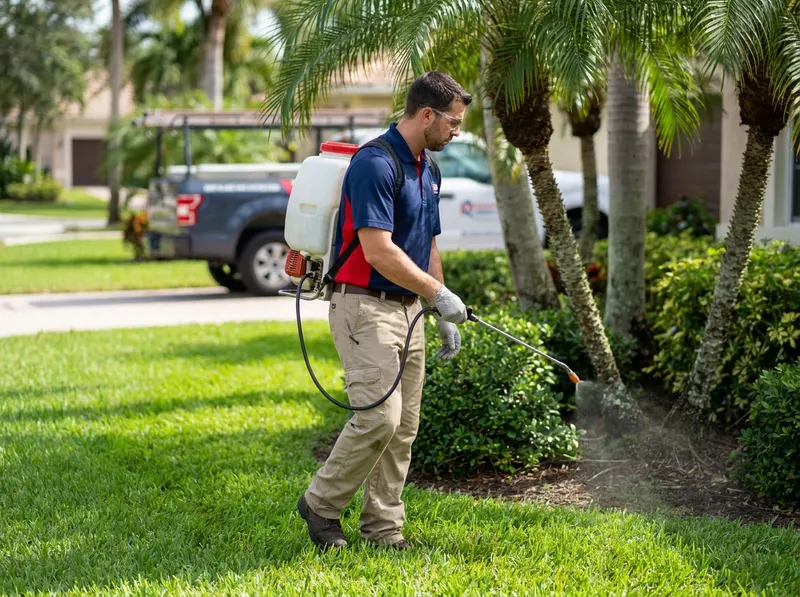
Flea and tick yard management in West Palm Beach requires understanding the tropical maritime climate of Palm Beach County, where elevated humidity and year-round warm temperatures remove the natural overwintering mortality seen in northern zones. Subtropical sandy soils common along Flagler Drive and neighborhoods like SoSo (South of Southern) and Providencia Park allow flea pupae to develop continuously without interruption. A standard service treats the transitional eco-tone: the damp zones beneath low-hanging ficus hedges, palm frond litter, shaded turf, and under wooden decking where larval stages develop away from direct sunlight. Outdoor suppression reduces pest pressure before pets bring vectors indoors, eliminating the reliance on retail broadcast sprays that degrade quickly under intense ultraviolet radiation. The regulatory framework established by the Florida Department of Agriculture and Consumer Services governs commercial applicator licensing and safety standards across our region.
Residential yards in El Cid, Flamingo Park, and Grandview Heights frequently feature dense, mature landscaping with established shade canopies that support flea and tick harborage. Moisture retention in dense St. Augustine or zoysia lawns creates microclimates where fleas thrive, while brown dog ticks climb vertical blades of grass and exterior masonry to latch onto hosts. Treatments utilize microencapsulated pyrethroids alongside insect growth regulators like pyriproxyfen, which interrupt the chitin development cycle of flea larvae so they cannot reach reproductive maturity, as documented by the University of Florida IFAS Extension. Environmental guidelines from the United States Environmental Protection Agency dictate precise application distances from stormwater canals and Lake Worth Lagoon to prevent aquatic contamination. For properties bordering open water, technicians use targeted granular larvicides rather than wide-angle mists to maintain ecological buffers.
Larger acreage tracts in Breakers West or perimeter-heavy lots near Northwood Village and Villages of Palm Beach Lakes require structured barrier treatments along fence lines and natural buffer corridors. According to vector surveillance data managed by the Centers for Disease Control and Prevention, vector-borne organisms such as Rickettsia require unbroken landscape suppression to prevent pet transmission. Granular systemic barriers prevent wandering ticks from crossing property boundaries from adjacent wooded parcels or golf course roughs. The companion animal safety protocols recognized by the American Veterinary Medical Association recommend keeping domestic dogs and cats indoors during application until the liquid barrier dries completely, which typically takes 60 to 90 minutes under South Florida ambient humidity.
Property managers preparing rental homes in Southland Park for turnover or homeowners experiencing an active yard infestation must balance broad-spectrum knockdowns with focused residual coatings. The standard operational sequence begins with an on-site property measurement to calculate exact square footage of shaded soil and dense ornamental turf. Technicians then apply a pressurized liquid residual barrier to foundational perimeters up to 3 feet up the wall and 5 feet outward into mulch beds, followed by an insect growth regulator treatment applied directly to known pet resting zones. Granular treatments are dispersed across open turf to penetrate deep into thatch layers where pupae shelter. The treatment regimen follows structural guidelines outlined by the National Pest Management Association, ensuring continuous control without requiring long-term service contracts. Ongoing property upkeep, such as regular mowing, leaf litter disposal per Palm Beach County solid waste schedules, and moisture mitigation through local water management standards from the South Florida Water Management District, reinforces perimeter chemical barriers against reinfestation.
Every job gets a firm, written price after a free on-site visit.
For standards, safe disposal, and service guidance on pest control services in West Palm Beach, FL, useful references include U.S. EPA, ENERGY STAR, U.S. Dept. of Energy, Consumer.gov, U.S. Census Bureau, and Google Maps. General consumer and small-business resources are available from USA.gov, Better Business Bureau, FTC Consumer Advice, U.S. Small Business Administration, and Ready.gov.
Tell us about your flea and tick yard management job in West Palm Beach and we'll send a clear, written quote, usually the same day.
 SecureHive Pest Management